
From Evolutionary Post-Metaphysics to Enlightened Praxis: Schelling, Whitehead, and the Meta-Perennial Completion
Chapter 14 from Meta-Perennial Philosophia: Integrating Evolution and Enlightenment

Chapter 14
From Evolutionary Post-Metaphysics to Enlightened Praxis: Schelling, Whitehead, and the Meta-Perennial Completion
An excerpt from
Meta-Perennial Philosophia: Integrating Evolution and Enlightenment
by Bradley Keith Reynolds
The heart of Integral philosophy is primarily a mental activity of coordinating, elucidating, and conceptually integrating all the various modes of knowing and being, so that, even if Integral philosophy itself does not deliver the higher modes, it fully acknowledges them, and then allows and invites philosophia to open itself to the practices and modes of contemplatio…. And, finally, it is a theoria that is inseparable from praxis, on all levels, in all quadrants.
—Ken Wilber (The Eye of Spirit, 1997, pp. 308-309, 1n)
I situate Meta-Perennial Philosophia in conscious continuity with the evolutionary natural philosophies of F. W. J. Schelling and Alfred North Whitehead, both of whom rejected static substance metaphysics in favor of a living, dynamic, and self-expressive Kosmos. As post-Kantian thinkers, Schelling and Hegel—and, in a later idiom, Whitehead—sought to move beyond Kant’s critical restriction of metaphysics by reconceiving nature, history, and Spirit as dynamically self- unfolding processes, thereby reopening ontological questions without reverting to pre-critical dogmatism or static transcendental structures. In this sense, their projects can be read as early philosophical forerunners of what Ken Wilber later articulates as an evolutionary post-metaphysical or Neo-Perennial approach—retaining ontological depth while translating metaphysical insight into developmental and process-oriented frameworks.
At the same time, both Schelling and Whitehead implicitly acknowledge that nature is not encountered “as it is in itself,” but as it is disclosed through historically and culturally mediated worldviews and modes of subjective knowing. Schelling’s Naturphilosophie broke decisively with mechanistic materialism by interpreting nature as productive, internally differentiated, and intrinsically oriented toward the emergence of consciousness and freedom (Schelling, 1809/1936). Likewise, Whitehead’s process ontology reconceived reality as a creative advance of actual occasions, replacing inert matter with relational becoming, felt experience, and perspectival prehension (Whitehead, 1929/1978). In this respect, both thinkers anticipate later post-metaphysical insights by recognizing that cosmology, ontology, and experience co-evolve, even as they remain committed to a real, intelligible Kosmos. Together, they provide indispensable foundations for any contemporary evolutionary spirituality that seeks to affirm meaning, creativity, and interiority without reverting to premodern supernaturalism.
Yet despite these profound anticipations, both Schelling and Whitehead ultimately locate Spirit’s self-disclosure within the arc of temporal development. For Schelling, the Absolute comes to self-knowledge through historical unfolding, emerging from a primordial ground (Ungrund) into conscious freedom. For Whitehead, God participates in the world’s creative advance, prehending and integrating each novel occasion into a growing consequent nature. In both cases, Spirit realizes itself through process. Becoming thus retains ontological priority, and Being—however elevated—is still functionally mediated by time.
From a Meta-Perennial standpoint, this is the precise point at which evolutionary metaphysics reaches its limit. Schelling anticipates Meta-Perennial Philosophia by recognizing evolution as Spirit’s living self-expression, but he stops short of the radical nondual insight that Enlightenment is always already the case and never produced by evolution—a gap the Meta-Perennial framework explicitly resolves by distinguishing and integrating Being-Enlightenment and Becoming-Evolution through Divine Recognition as being always already present (not the endpoint of the evolutionary journey).
Enlightenment belongs to the Arc of Being,
not the Arc of Becoming.
It is the always-already Divine Condition,
recognized—not achieved—
through Divine Self-Recognition.
Meta-Perennial Philosophia affirms the evolutionary insights of Schelling and Whitehead while introducing a decisive nondual clarification: Being does not Become; It IS. Evolution describes the unfolding of form, complexity, and relational integration, but Enlightenment is not the culmination of that unfolding. Enlightenment belongs to the Arc of Being, not the Arc of Becoming. It is the always-already Divine Condition, recognized—not achieved—through Divine Self-Recognition. Where Schelling and Whitehead describe Spirit as becoming conscious of itself in time, I insist that consciousness awakens to what was never absent. Evolution may illuminate how Reality appears; it does not generate Reality as It IS.
This distinction does not negate evolutionary metaphysics; it completes it. By clearly differentiating Being-Enlightenment from Becoming-Evolution, Meta-Perennial Philosophia resolves the latent tension within both German Idealism and process thought, between ontological immediacy and historical emergence. Whitehead’s “creative advance into novelty” remains a profound account of Becoming, yet it is no longer burdened with the impossible task of producing Enlightenment. Similarly, Schelling’s dynamic polarities—ground and existence, contraction and expansion—are retained, but they are re-situated within a nondual Prior Unity that is not itself subject to development. In this way, Meta-Perennial Philosophy reframes evolutionary cosmology as expressive rather than constitutive of the Divine.
At this juncture, Ken Wilber’s important critique of German Idealism becomes decisive. Wilber argues that the Idealists—including Schelling, Johann Gottlieb Fichte, and G. W. F. Hegel—possessed profound transpersonal intuitions but had “no yoga,” meaning no reliable, reproducible psycho-spiritual discipline for stabilizing and transmitting those insights (Wilber, 1998, pp. 112–114). Their realizations emerged “haphazardly and randomly,” lacking what Wilber calls an “industrial-strength” contemplative practice capable of delivering sustained nondual awareness across persons and generations. As Wilber (2006) notes, without such reproducible injunctions, transpersonal insight easily degenerates into “mere metaphysics”—that is, philosophical speculation without embodied verification or transformative power.
This absence of yogic discipline is not a minor historical oversight; it marks a structural limitation. While Idealists such as Hegel articulated extraordinarily sophisticated dialectical visions of Absolute Spirit coming to self-knowledge through history, they lacked the somatic, energetic, and devotional technologies—breath, posture, bodily conductivity, ethical discipline, and sustained contemplative absorption—through which consciousness itself is transformed. As a result, their philosophies could gesture toward nondual awareness but could not reliably deliver it. Meta-Perennial Philosophia addresses this lacuna directly by reintegrating Right Life disciplines, yogic conductivity practices, and devotional surrender as indispensable supports for spiritual maturation, without confusing those supports with the act of Enlightenment itself.
A similar limitation, though expressed in a different philosophical idiom, is evident in Alfred North Whitehead (1861–1947). Whitehead’s process philosophy offers one of the most sophisticated metaphysical accounts of Becoming ever articulated, reconceiving reality as a creative advance of relational occasions rather than a world of static substances. Yet despite the spiritual depth of his cosmology, Whitehead provides no corresponding yogic, contemplative, or psycho-somatic praxis capable of transforming the practitioner’s consciousness in a reproducible manner. His metaphysics of feeling, prehension, and creativity illuminates how reality unfolds, but it does not supply the embodied disciplines through which the self-contraction is transcended or nondual Divine Recognition is stabilized. As with German Idealism, the absence of a lived yogic path means that Whitehead’s vision remains primarily speculative and interpretive rather than initiatory.
Meta-Perennial Philosophia affirms Whitehead’s account of Becoming while recognizing that Enlightenment cannot arise from metaphysical insight alone; it requires Right Life, yogic conductivity, and Adept-Transmission to move from philosophical comprehension to embodied Divine Recognition.
The decisive addition absent from both Schelling and Whitehead, and only implicitly recognized by Wilber, is the explicit recognition of Adept-Transmission as ontologically central. Enlightenment is not merely a philosophical insight or metaphysical culmination; it is awakened through Divine Self-Recognition catalyzed by Spirit-Transmission from an Awakened Adept, as articulated most rigorously by Adi Da Samraj. This introduces a dimension of spiritual causality irreducible to evolutionary emergence, psychological refinement, or conceptual synthesis. Development may prepare the body-mind through Right Life and yogic conductivity; it does not dissolve the self-contraction. Only Divine Recognition does.
In this respect, Meta-Perennial Philosophia also completes Wilber’s evolutionary spirituality. While his Neo-Perennial framework brilliantly integrates development, evolution, and post-metaphysical epistemology, it occasionally situates Enlightenment too closely within an evolutionary narrative of ascent. By introducing Offering Up (devotional surrender) and Brightening Up (radical ego-transcendence through Divine Recognition), Meta-Perennial Philosophy safeguards nondual Realization from developmental absolutism while preserving the indispensable value of Waking Up, Growing Up, Cleaning Up, Opening Up, and Showing Up. Structural maturity may harmonize Awakening; it never causes it.
Evolution is Spirit-in-action;
Enlightenment is Spirit-as-presence.
Thus, Meta-Perennial Philosophia stands as a post-Idealist, post-process, and post-Integral completion of evolutionary metaphysics. It affirms Schelling’s vision of nature as living Spirit, Whitehead’s insight into relational becoming, and Wilber’s cartography of developmental complexity—yet grounds them all in the ontological primacy of Being-Enlightenment. Evolution is Spirit-in-action; Enlightenment is Spirit-as-presence. When these Two Arcs are distinguished without separation and integrated without collapse, evolutionary philosophy is liberated from the burden of producing God, and nondual spirituality is freed from denying the world. What remains is a unified vision of Reality as It IS—timelessly present, historically expressive, and always already the case.
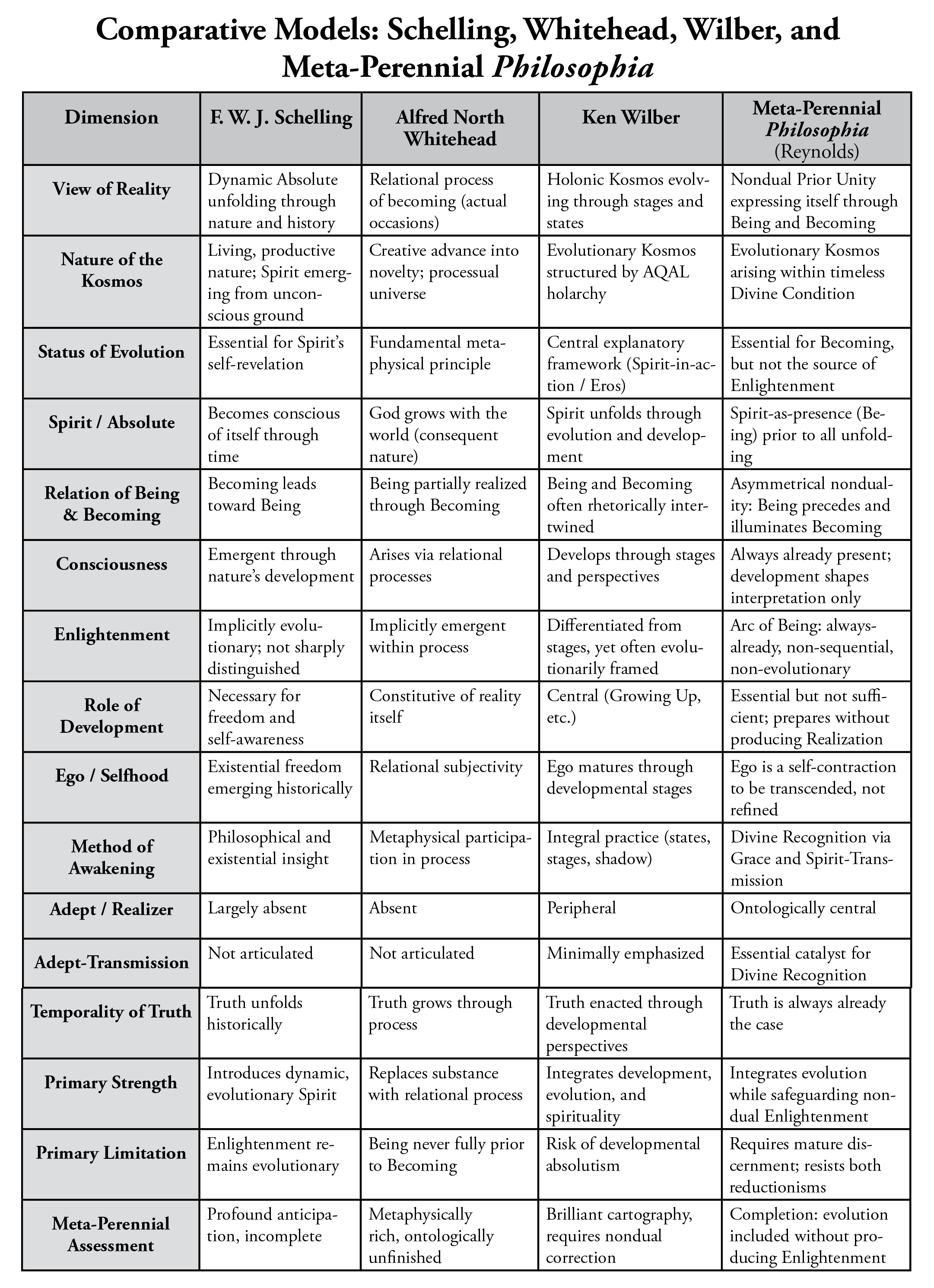
To clarify these continuities and differences, the table below sets Schelling, Whitehead, and Wilber alongside the Meta-Perennial framework [see the table below].
_______________________________________________________________
This essay reflects themes developed more fully in my book:
Meta-Perennial Philosophia:
Integrating Evolution and Enlightenment
An attempt to clarify the relationship between spiritual realization and developmental understanding in a time of global Meaning Crisis.
📘 Available now (paperback & Kindle):
https://www.amazon.com/dp/B0GP85WSCG
🎬 Watch the short overview trailer:
If you found this essay meaningful, consider subscribing to support ongoing work at the intersection of philosophy, spirituality, and culture through Integral Art & Studies.
Nicely done! You do this very well, my friend!!! love and blessings, randall DA