
Metaphysical Deflation
Frank Visser and the Conflation of “Mystical Oneness”

“If you want to know God, you must awaken, not merely theorize.”
—Ken Wilber, 2003
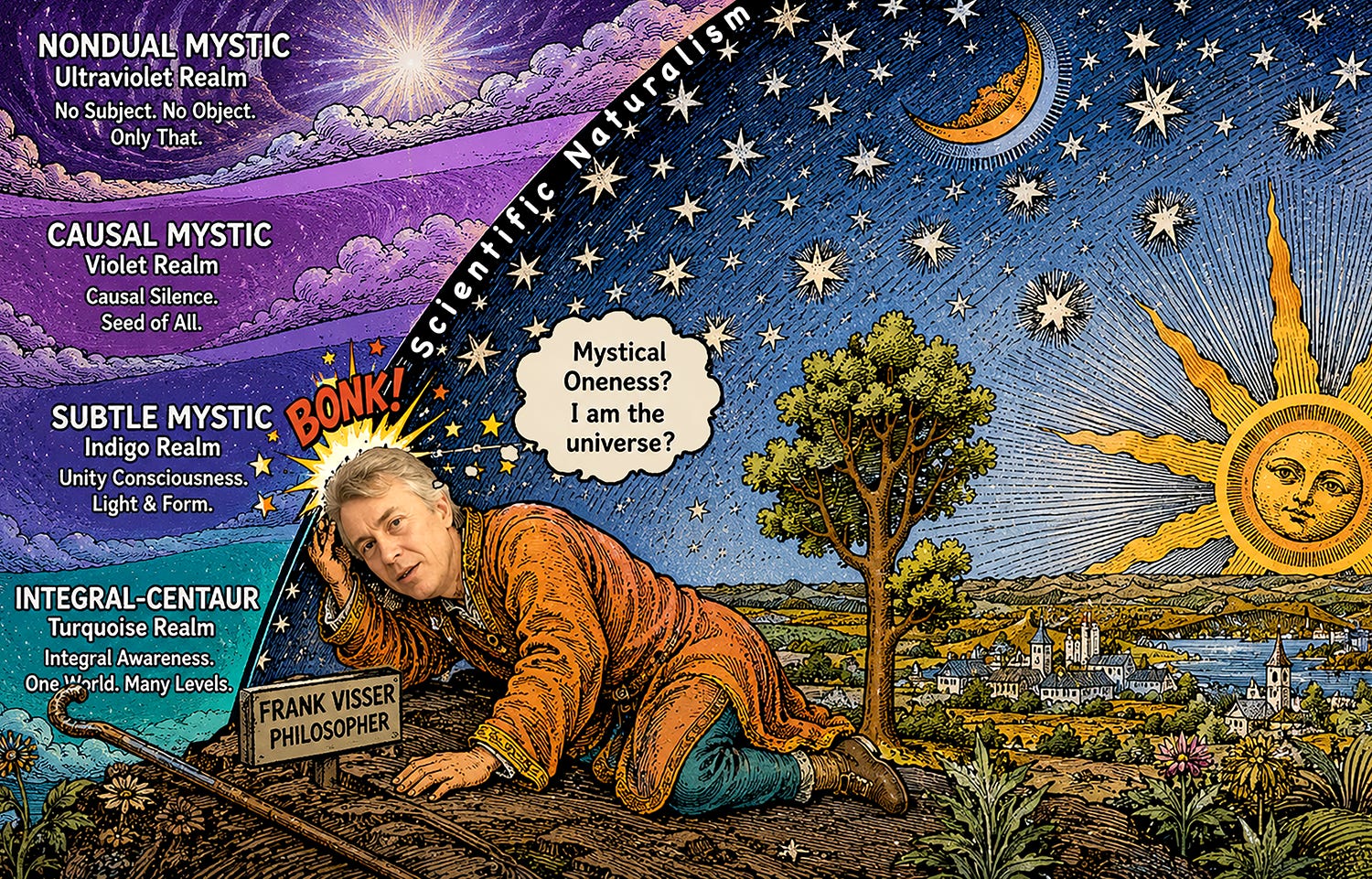
Frank Visser’s “Mystical Boundary” (after the Flammarion Engraving, 1888)
Metaphysical Deflation:
Frank Visser and the Conflation
of “Mystical Oneness”
By Brad Reynolds
Frank Visser’s essay, “Mystical Oneness: Experience, Interpretation, and the Problem of Metaphysical Inflation,” presents itself as a disciplined attempt to distinguish mystical experience from metaphysical overreach. On the surface, this sounds reasonable. No serious contemplative philosopher should deny that experience is interpreted, that traditions provide symbolic frameworks, or that premature metaphysical conclusions can occur.
The problem is that Visser’s essay does not merely caution against inflation; it deflates the entire spiritual enterprise by beginning with a distorted premise: that mystical awakening primarily means “oneness with the universe.” The world’s wisdom traditions do not speak with one voice about “oneness”; they distinguish multiple forms and stages of mystical realization culminating, in some traditions, not in oneness with the universe but in the direct recognition of the Source or Ground of all existence. This recognition is not founded upon merely subjective experience or conceptual interpretation, but upon the disclosure of Reality as it IS. It is the difference between Waking Up and Awakening, between transpersonal mystical experience and Enlightenment itself—the utter transcendence of the separate self.
That is already the first and decisive error Visser perpetuates.
The great traditions are not ultimately pointing to “oneness with the universe” understood as personal identity with the physical cosmos. They are pointing to the Source, Ground, Godhead, Brahman, Dharmakāya, Tao, Ein Sof, or Divine Condition in which all worlds, all minds, all beings, and all universes arise. “All” refers to the totality of existence, not an astronomical inventory. Thus, Visser misses the mark when he repeatedly frames the issue as whether “the self is literally identical with the universe.” Rather, true mystical oneness means that the separate-self sense is undone in relation to—or as direct recognition of—the prior Reality from which subject and object, interior and exterior, self and world, knower and known—indeed, all existence—arise, exist, and pass away.
This is exactly where Visser’s analysis collapses. He takes a lower or intermediate form of mystical experience—cosmic unity, nature mysticism, ego dissolution, or immersive oneness—and treats it as if this exhausts the meaning of spiritual realization. But as I argue in my book Meta-Perennial Philosophia (2026), experiences of unity consciousness belong to the spectrum of Nature Mysticism or cosmic consciousness; they may be profound (and are), but they still arise as experiences to an experiencing subject. Divine Recognition or Enlightenment, by contrast, is not merely being unified with phenomena, but the direct recognition of the very Source of all phenomena (interior and exterior)—the Divine Ground of Being (or Dharmadhātu) within which all phenomena already exist.
Thus, Visser’s critique is aimed at the wrong target. He criticizes “oneness with the universe,” while the highest traditions are speaking of oneness with, or recognition as, the Source of all universes, which is Being Itself. Visser’s understanding of mystical oneness is still an experience within the Arc of Becoming (or evolutionary manifestation) because he does not understand or appreciate the essential differentiations disclosed throughout the transpersonal spectrum of mysticism. In other words, he does not adequately comprehend Ken Wilber’s map of consciousness-reality, for Wilber’s Integral Metatheory clearly makes these distinctions in alignment with the Great Wisdom Traditions.
Visser’s reduction begins with the statement that mystical oneness “typically points to a collapse or attenuation of ordinary subject-object structuring.” But this is an external description, not an adequate spiritual phenomenology. Certainly, subject-object structures may relax, dissolve, or be transcended in contemplative states, true. But to reduce mystical realization to “attenuated subject-object structuring” is like reducing love to oxytocin, music to air vibration, or moral conscience to social conditioning. It is not false at one level; it is simply profoundly incomplete.
Visser never actually demonstrates that contemplative realization cannot disclose ontology. Instead, he repeatedly redescribes the experience in increasingly deflationary terms until its ontological significance simply evaporates. But that is not an argument—it is a rhetorical strategy. To redescribe a phenomenon is not to explain it away.
It is rather like saying that Beethoven’s Ninth Symphony is “nothing more than coordinated air-pressure fluctuations interpreted by mammalian auditory systems.” At one level, every word is scientifically accurate. Yet nothing essential about Beethoven’s music has actually been explained. The aesthetic reality has simply been translated into a vocabulary incapable of recognizing it. Likewise, mystical realization can be redescribed in neurocognitive, psychological, or linguistic terms without thereby exhausting—or refuting—its possible ontological significance.
Visser Misses Integral
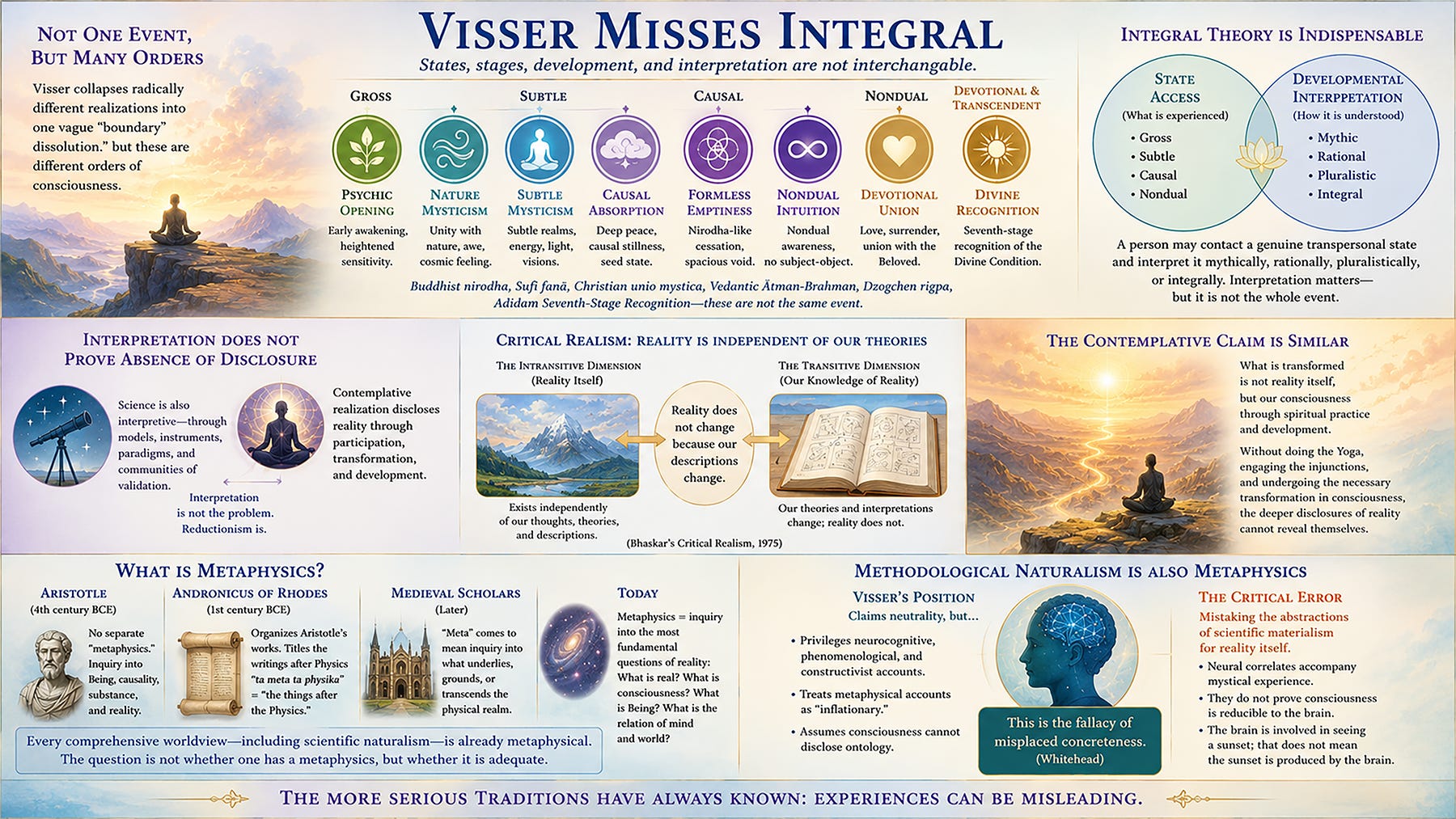
The deeper issue is that Visser lacks a developmental and state-stage map. He lists “undifferentiated awareness, non-dual awareness, ego dissolution, or immersive unity” as if these are roughly interchangeable descriptions generated by cultural language. But they are not interchangeable. They represent different orders of realization altogether: psychic opening, subtle mysticism, causal absorption, nondual intuition, devotional union, nature mysticism, formless emptiness, or Divine Recognition. A Buddhist nirodha-like cessation, a Sufi fanā, a Christian unio mystica, a Vedantic recognition of Ātman-Brahman, a Dzogchen glimpse of rigpa, and an Adidam seventh-stage recognition of the Divine Condition cannot responsibly be collapsed into one generic “boundary dissolution” event.
This is where Integral theory is indispensable. Wilber’s state-stage distinction clarifies that access to gross, subtle, causal, and nondual states is one axis, while developmental interpretation is another. A person may contact a genuine transpersonal state and interpret it mythically, rationally, pluralistically, or integrally. Visser is correct that interpretation matters, but he mistakes interpretation for the whole event. He notices that mystical states are interpreted, and then subtly implies that interpretation exhausts their meaning. Visser conflates the varieties of religious experience (James, 1902) into a single category—scientific naturalism—where he can attempt to understand what he has not yet experienced; but, in doing so, he gets lost in category errors.
The existence of interpretation does not prove the absence of disclosure. Scientific data are also interpreted through models, instruments, paradigms, and communities of validation; no one therefore concludes that science is merely interpretive fiction. As Roy Bhaskar’s Critical Realism (1975) maintains, reality itself (the intransitive dimension) exists independently of our changing theories and interpretations of it (the transitive dimension). Reality does not change simply because our descriptions change; rather, our understanding progressively approximates what is already the case. The contemplative traditions make a similar claim. What is transformed is not reality itself, but our consciousness through spiritual practice and development. Without doing the Yoga, engaging the injunctions, and undergoing the necessary transformation in consciousness, the deeper disclosures of reality cannot reveal themselves. Reality discloses itself through participation, not merely through interpretation.
What Is Metaphysics?
Visser repeatedly employs the word “metaphysics” as though it were synonymous with speculative cosmology or unverifiable supernatural belief. Yet this usage obscures the philosophical meaning of the term itself. Historically, the word metaphysics did not originally mean “beyond the physical world.” Aristotle never used the word, nor did he conceive of “metaphysics” as a separate philosophical discipline. The title originated in the first century BCE, when the philosopher Andronicus of Rhodes was organizing the collected works of Aristotle. The writings that came after (meta) the books on Physics (the study of nature) were called Metaphysics. Andronicus labeled these treatises with the Greek phrase ta meta ta physika, which simply translates as “the things after the Physics.” Originally, this was merely an editorial designation, not a philosophical doctrine. Over time, “meta” took on a deeper meaning. Medieval scholars began interpreting the prefix not just as sequential (“after”), but as denoting inquiry into what underlies, grounds, or transcends the physical realm.
Over time, the term came to designate inquiry into the most fundamental questions of reality: What is ultimately real? What is consciousness? What is Being? What is causality? What is the relation between mind and world? In this sense, every comprehensive worldview—including scientific naturalism—is already “metaphysical,” because every worldview makes fundamental ontological assumptions about reality, whether acknowledged or not. The real question is not whether one has a metaphysics, but whether one’s metaphysical assumptions are adequate to the phenomena under investigation. Visser criticizes mystical metaphysics while overlooking the fact that methodological naturalism, physicalism, and the assumption that consciousness cannot disclose ontology are themselves metaphysical commitments. The debate, therefore, is not between metaphysics and no metaphysics; it is between competing metaphysical or fundamental visions of reality.
Visser’s essay repeatedly privileges modern naturalistic metaphysics while pretending to stand in neutral philosophical space. His “neurocognitive,” “phenomenological,” and “constructivist” accounts are treated as modest and disciplined, whereas metaphysical accounts are treated as inflationary. But that is not neutrality. That is methodological naturalism smuggled in as metaphysical superiority. Or, to borrow Alfred North Whitehead’s famous criticism, this is the fallacy of misplaced concreteness: mistaking the abstractions of scientific materialism for reality itself. To say that neural correlates accompany mystical experience tells us that embodied consciousness has measurable correlates. It does not tell us whether consciousness is reducible to those correlates, nor whether contemplative realization discloses real features of Being. The brain is involved in seeing a sunset; that does not mean the sunset is produced by the brain. Likewise, the brain participates in mystical realization; that does not prove that mystical realization is nothing but brain-state alteration.
The more serious traditions have always known that experiences can be misleading. This is why Yoga distinguishes samadhi from liberation, Buddhism distinguishes meditative absorption from awakening, Christianity distinguishes consolations from union with God, Sufism distinguishes passing states from stabilized realization, and Adi Da distinguishes all conditional mystical experiences from seventh-stage Divine Recognition. In Chapter 18, I make the same point explicitly: subtle visions, kundalini movements, siddhis, archetypal encounters, causal absorption, and formless bliss remain conditional experiences within the Arc of Becoming; they do not, by themselves, dissolve the root-activity of egoity. Divine Recognition belongs to another order altogether: the tacit intuition of the always already Divine Condition prior to all arising or, in my terminology, within the embrace of the Arc of Being.
Therefore, Visser is correct in his argument only against naïve mysticism. Yes, some people inflate temporary openings. Yes, ego dissolution can be mistaken for enlightenment. Yes, cultural frameworks shape interpretation. Yes, mystical rhetoric can become grandiose. But none of this touches the strongest claims of the Great Tradition of Global Wisdom (Reynolds, 2025). In fact, the mature traditions already contain internal safeguards against precisely the errors Visser thinks he has exposed. The problem is that he treats immature metaphysical inflation as if it were the essence of mysticism itself. This is not philosophical neutrality; it is metaphysical deflation. This is not philosophical neutrality; it is metaphysical deflation.
“The Universe” is Not Merely Astronomical Expanse
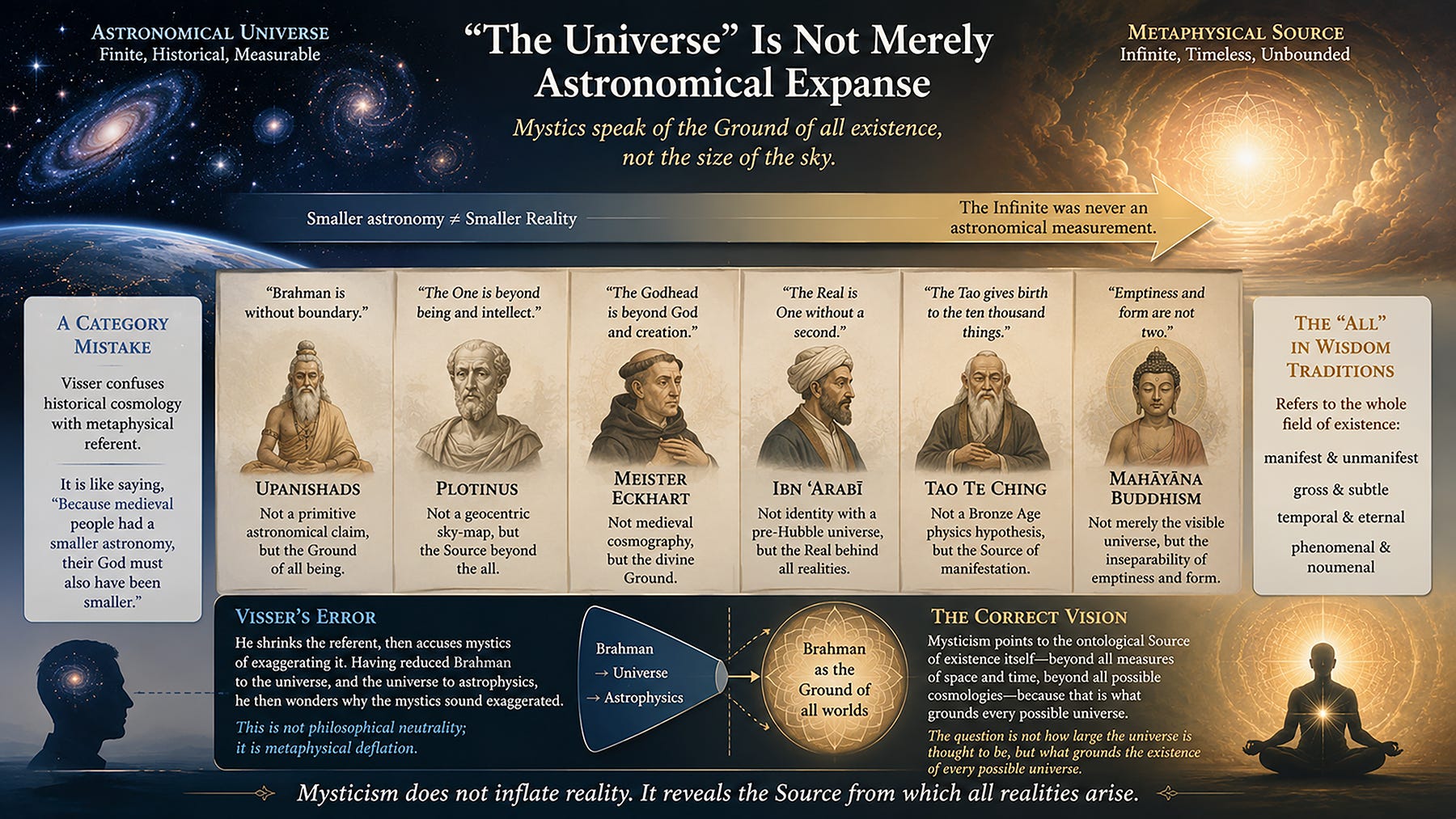
Visser’s historical argument about what “the universe” means is especially weak. He argues that ancient mystics could not have meant the modern universe of billions of galaxies, since they lived within finite, hierarchical, premodern cosmologies. But this is a category mistake; it confuses historical cosmology with metaphysical referent.
When the Upanishads speak of Brahman, they are not making a primitive astronomical claim. When Plotinus speaks of the One, he is not referring to a geocentric sky-map. When Meister Eckhart speaks of the Godhead, he is not describing medieval cosmography. When Ibn ‘Arabī speaks of the Real, he is not asserting identity with a pre-Hubble universe. When the Tao Te Ching speaks of the Tao that gives birth to the ten thousand things, it is not offering a Bronze Age physics hypothesis. They are speaking of the Ground of manifestation. The question is not how large the universe was thought to be, but what grounds the existence of every possible universe. Mysticism points to the ontological Source of existence itself, regardless of how spacious the physical universe is conceived to be. Visser’s argument confuses cosmological imagery with metaphysical intent. It is rather like saying, “Because medieval people had a smaller astronomy, their God must also have been smaller.” But the Infinite was never an astronomical measurement. It was a metaphysical and contemplative realization, the recognition of how reality really IS.
His phrase “rhetorical inflation” is therefore revealing. It assumes that when mystics speak of the “All,” they are making an empirical claim about the physical cosmos. But the “All” in the wisdom traditions usually refers to the whole field of existence: manifest and unmanifest, gross and subtle, temporal and eternal, phenomenal and noumenal. In Sanskrit terms, it is not merely jagat, the manifest world, but Brahman as the Ground of all worlds. In Mahāyāna Buddhism, it is not merely the visible universe, but emptiness-form inseparability. In Christian apophatic mysticism, it is not created nature alone, but the Godhead beyond God the Creator. In Kabbalah, it is not the measurable cosmos of stars, but Ein Sof and its emanations. Visser shrinks the referent, then accuses mystics of exaggerating it. Having reduced Brahman to the universe, and the universe to astrophysics, he then wonders why the mystics sound exaggerated. This is not philosophical neutrality; it is metaphysical deflation. Once again, a severe category error.
Identity Language
A further problem is Visser’s treatment of identity-language. He writes that phrases such as “Everything is me” or “There is only consciousness” are metaphorical descriptions of boundary dissolution, “not logically necessary conclusions” about reality. But this assumes that logic, specifically discursive rational inference, is the only valid route to knowledge. The contemplative traditions claim otherwise. They claim that consciousness and the truth about existence and reality can be known by identity-transcendence, participation, illumination, or direct recognition. This does not mean every such claim is true. But it means Visser cannot dismiss them simply because they are not deduced in the form of analytic propositions or measurable mathematics.
William James famously identified mystical states as noetic, they are felt by the experiencer to disclose knowledge, not merely emotion (James, 1902). W. T. Stace distinguished introvertive and extrovertive mysticism, both involving a unitive apprehension that cannot be reduced to ordinary perception (Stace, 1960). Evelyn Underhill described the mystical path as involving purification, illumination, and union—not merely an altered self-model (Underhill, 1911). Rudolf Otto analyzed the numinous as a sui generis category of experience irreducible to morality, rationality, or affect alone (Otto, 1917). Huston Smith repeatedly argued that the religious traditions preserve empirically disciplined modes of interior verification, not mere speculative projection (Smith, 1976). Visser writes as if the debate begins with neuroscience and constructivism when in fact he is attempting to enter a much older, richer, and more philosophically disciplined conversation—one whose central arguments he neither adequately acknowledges nor successfully engages. Visser is, in effect, an unschooled neophyte posing as an expert on mysticism.
Beyond Constructivism
The constructivist point—that traditions shape mystical interpretation—is valid but limited. Steven Katz (1978) and others rightly challenged the idea of completely “pure” experience untouched by language or culture. But the stronger perennialist and integral response is not that all experiences are identical. Rather, it is that the contemplative traditions disclose recurring structures and stages of consciousness that are interpreted through different symbolic systems. The fact that Christian, Buddhist, Sufi, Taoist, Vedantic, and Dzogchen realizers use different vocabularies does not prove that there is no common referent. It proves only that realization must become communicable through language, and language is always traditioned. Constructivism therefore reminds us that realization is interpreted; it does not demonstrate that realization is merely interpretation.
Here Wilber’s contribution remains crucial. States of consciousness are universal potentials; interpretations are developmentally and culturally mediated. This both honors Visser’s concern and surpasses it. But the Meta-Perennial correction goes further: even Wilber’s state model must be clarified so that nondual state-experience is not confused with Divine Recognition or Enlightenment. In Chapter 18, I argue that Waking Up is best understood as access to subtle, causal, and nondual states, while Awakening properly refers to the direct awakening to the Divine Condition. States come and go; Recognition sees (and knows) Reality as It IS, beyond all temporary conditions and interpretations.
This distinction is devastating to Visser’s critique because it shows that his “oneness” category is too crude and reductionistic. Unity with nature is not the same as subtle visionary mysticism. Subtle visionary mysticism is not the same as causal formless absorption. Causal formless absorption is not the same as nondual awareness. Nondual awareness as a temporary state is not the same as stabilized Divine Recognition. And Divine Recognition is not “identity with the universe,” but the release of the separate-self presumption in the Source-Condition of all arising.
Visser’s No Yoga = Metaphysical Deflation
Visser’s essay also fails to account for transformative contemplative practice (praxis), or what Ken Wilber calls the Eye of Spirit.[1] He treats mystical claims as reports that arise as brain phenomena that are then interpreted by a subjective self with all of its prejudices and limitations. But in the traditions, realization is not merely a spontaneous anomaly. It is cultivated, tested, stabilized, embodied, and confirmed through disciplines of attention, devotion, ethics, breath, surrender, discrimination, and transmission. Patañjali’s Yoga, Buddhist śamatha-vipaśyanā, Sufi dhikr, Hesychast prayer, Vedantic inquiry, Dzogchen pointing-out instruction, and Adidam’s Way of the Heart all involve repeatable modes of transformation. These are not random private feelings. They are disciplined methods of consciousness transformation.
To be sure, they are not “scientific” in the narrow third-person laboratory sense. But neither are they arbitrary. They operate through first-person and second-person modes of verification: practice, transmission, teacher-student relationship, community, scripture, ethical fruit, and transformation of life. Visser’s analysis is almost entirely third-person and retrospective. It stands outside the contemplative process and then declares what the process can and cannot mean. This is rather like someone who has never practiced music analyzing Beethoven solely through the acoustics of vibrating strings and calling musical meaning “interpretive inflation.”
The wisdom traditions do not deny that the ego can inflate mystical experience. They insist on discriminating against this danger. That is why purification, humility, devotion, surrender, ethical conduct, and guidance are central. The real critique of inflated mysticism comes not from reductive skepticism, but from the higher standards of the traditions themselves. Adi Da’s critique is far more radical than Visser’s because it does not merely say “you are interpreting too much.” It says: even your most exalted mystical states are still conditional if the self-contraction remains as an activity in consciousness. That is a much more profound deflation of egoic mysticism—but it is not a deflation of Divine Reality.
Visser’s “problem of metaphysical inflation” therefore needs to be inverted. The deeper problem today is not only that mystics inflate experience into metaphysics. It is also that modern skeptics deflate metaphysical disclosure into psychology, neuroscience, and cultural linguistics. This is metaphysical deflation. It is just as interpretive, just as worldview-bound, and just as prone to overreach as the religious claims it criticizes. The rational ego sees transcendence and calls it projection. The scientific materialist sees consciousness and calls it brain activity. The constructivist sees symbolic diversity and calls it social production. Each is an interpretation. None is neutral.
An Integral Approach to “Metaphysics”: The Meta-Perennial Corrective
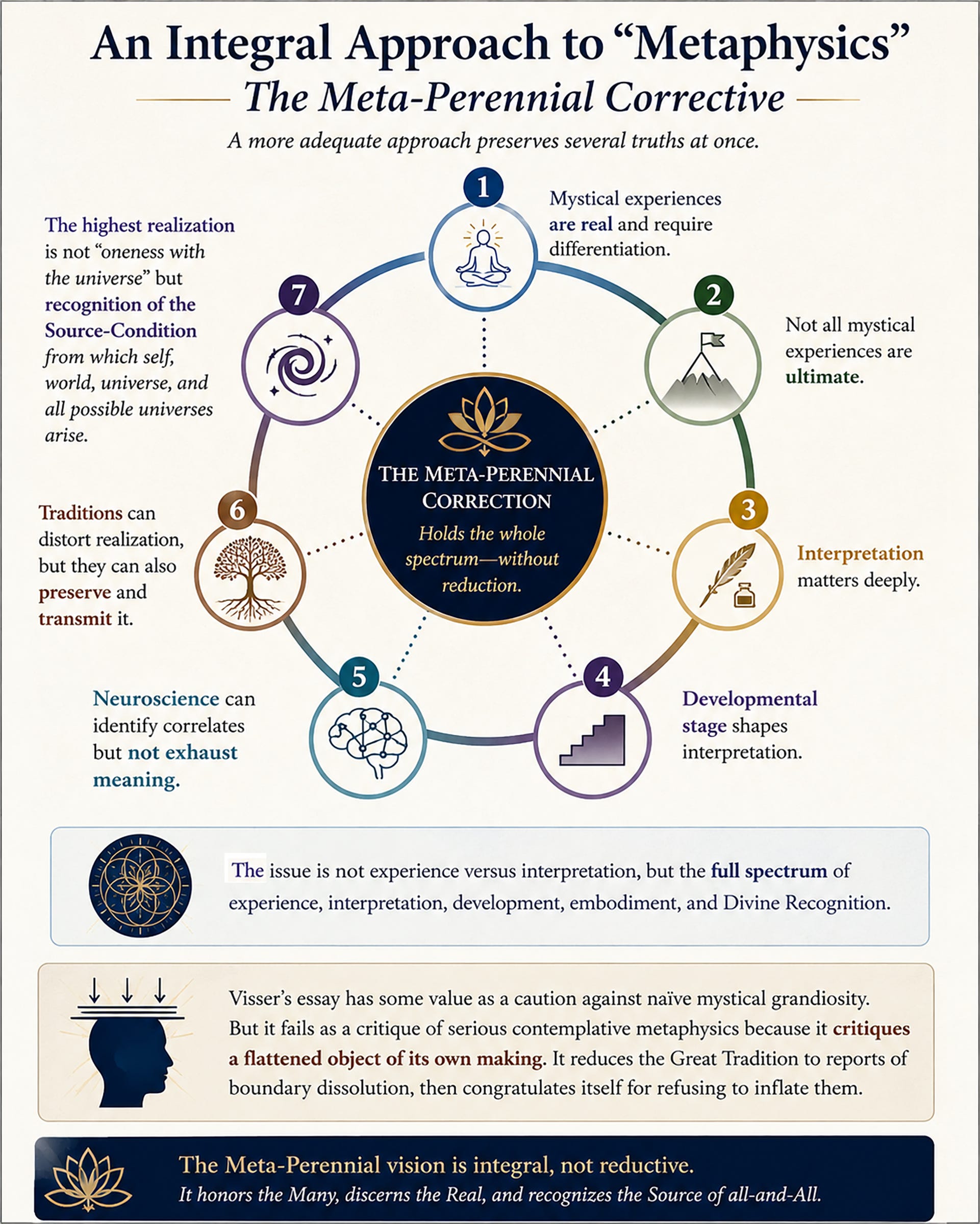
A more adequate approach would preserve several truths at once.
First, mystical experiences are real and require differentiation.
Second, not all mystical experiences are ultimate.
Third, interpretation matters deeply.
Fourth, developmental stage shapes interpretation.
Fifth, neuroscience can identify correlates but not exhaust meaning.
Sixth, traditions can distort realization, but they can also preserve and transmit it.
Seventh, the highest realization is not “oneness with the universe” but recognition of the Source-Condition from which self, world, universe, and all possible universes arise.
This is the Meta-Perennial correction. The issue is not experience versus interpretation, but the full spectrum of experience, interpretation, development, embodiment, and Divine Recognition. Visser’s essay has some value as a caution against naïve mystical grandiosity. But it fails as a critique of serious contemplative metaphysics because it critiques a flattened object of its own making. It reduces the Great Tradition to reports of boundary dissolution, then congratulates itself for refusing to inflate them.
Collapsing Ontology into Psychology
The final irony is that Visser accuses mystics of rushing from experience to ontology, while he rushes from neurocognitive and constructivist description to ontological skepticism. He does not prove that mystical realization fails to disclose ultimate Reality. He merely redescribes it in terms acceptable to the modern rational mind. But redescription is not refutation. This is not philosophical neutrality; it is metaphysical deflation.
The mystic does not claim, at the highest level, “I am numerically identical with the physical universe.” The mystic recognizes that the separate self was never ultimately separate from the Ground of Being. The wave realizes it was never other than the ocean—not because it has measured all the water, but because its very substance is water. Visser keeps asking whether the wave has inspected the whole sea. The contemplative answer is: that is not the point. The point is the recognition of the Source.
Thus, the proper response to Visser is not anti-intellectualism. It is better discrimination. Differentiate states from stages. Differentiate unity consciousness from Divine Recognition. Differentiate cosmic feeling from causal absorption. Differentiate symbolic interpretation from contemplative disclosure. Differentiate neural correlation from ontological reduction. Differentiate the universe as physical object from the All as totality of existence. And above all, differentiate the ego’s inflation of experience from the genuine transcendence of ego in the always already Divine Condition.
Visser’s essay is not wrong because it is too rational. It is wrong because it is not integral enough. It lacks the very differentiations required to understand the phenomena it criticizes. It sees mystical language, suspects inflation, and mistakes suspicion for explanation. But the Great Tradition begins where that suspicion ends: in disciplined praxis, transformation, surrender, and the direct recognition of the Source of all-and-All. As I have emphasized throughout Meta-Perennial Philosophia: praxis precedes interpretation. Transformation is itself an epistemic condition and disclosure. A person literally cannot interpret the highest realizations correctly until consciousness itself has been transformed. Without transformation, the debate remains largely theoretical.
_________________________________________________
References
Adi Da Samraj. (2009). The Aletheon. The Dawn Horse Press.
Adi Da Samraj. (2011). The perfect knowledge of God. The Dawn Horse Press.
James, W. (1985). The varieties of religious experience. Harvard University Press. (Original work published 1902)
Katz, S. T. (Ed.). (1978). Mysticism and philosophical analysis. Oxford University Press
Otto, R. (1958). The idea of the holy (J. W. Harvey, Trans.). Oxford University Press. (Original work published 1917)
Reynolds, B. (2025). The universal tradition of global wisdom. Bright Alliance.
Reynolds, B. K. (2026). Meta-perennial philosophia. Bright Alliance.
Smith, H. (1976). Forgotten truth: The common vision of the world’s religions. Harper & Row.
Smith, H. (1982). Beyond the post-modern mind. Crossroad.
Stace, W. T. (1960). Mysticism and philosophy. Macmillan.
Underhill, E. (1990). Mysticism: The nature and development of spiritual consciousness. Oneworld. (Original work published 1911)
Wilber, K. (2001). Eye to eye: The quest for the new paradigm (Rev. ed.). Shambhala. (Original work published 1983)
Wilber, K. (2000). Integral psychology. Shambhala.
Wilber, K. (2006). Integral spirituality. Integral Books.
Wilber, K. (2024). Finding radical wholeness. Shambhala.
[1] Ken Wilber uses the term Eye of Spirit to describe the contemplative mode of knowing cultivated through meditation, prayer, contemplation, and other transformative spiritual disciplines. Like the empirical sciences, these practices employ specific methods or injunctions, experiential data, and communities of verification appropriate to their domain. See Ken Wilber, Eye to Eye: The Quest for the New Paradigm (Boston: Shambhala, 1983).
_______________________________________________________________
This essay reflects themes developed more fully in my book:

📘 Available now (paperback & Kindle):
https://www.amazon.com/dp/B0GP85WSCG
Meta-Perennial Philosophia:
Integrating Evolution and Enlightenment
An attempt to clarify the relationship between spiritual realization and developmental understanding in a time of global Meaning Crisis.
🎬 Watch the short overview trailer:
If you found this essay meaningful, consider subscribing to support ongoing work at the intersection of philosophy, spirituality, and culture through Integral Art & Studies.